Authors: Andrew R. Bohm, PhD, MS1, Rebecca Teng, BA2, Sarah Ulcoq, OTR/L2, Giles R. Scuderi, MD1
1Lenox Hill Hospital, Northwell Health, New York, NY
2Force Therapeutics, New York, NY
Abstract
Introduction
In light of the opioid epidemic, it’s crucial to evaluate the impact of postoperative pain management options on patient reported outcomes and recovery, and iterate on opioid prescribing guidelines. Patient reported use of opioids after Total Knee Arthroplasty (TKA) is not well understood. The American Society of Addiction Medicine (ASAM) recommends carefully assessing the benefits of an opioid dose exceeding 50 morphine milligram equivalents (MME)/day because of the additional risks associated with exposing patients to higher opioid levels. Utilizing patient reported dosage, we sought to test if patient reported outcomes differ based on the ASAM threshold of high-dose opioid usage.
Materials & Methods
Patients undergoing primary TKA were enrolled on an online-based physical therapy program per standard of care. Patients were asked to report daily pain and medication usage at preoperative and 30 days after surgery. Patients completed KOOs Jr, VR-12, and patient satisfaction surveys throughout their care plan. Daily milligrams of morphine equivalent (MME) were calculated from reported opioid type, dose, and number of pills consumed to standardize across opioids of different strength. Patients were categorized into 2 groups: High-dose: use of excess of 50 MME/da, and Low-dose: use below 50 MME/day. KOOS Jr, VR-12, patient satisfaction, and highest pain evel were compared between the two groups at preoperative and postoperative timepoints: 6 weeks, 12 weeks, 6 months, 1 year.
Results
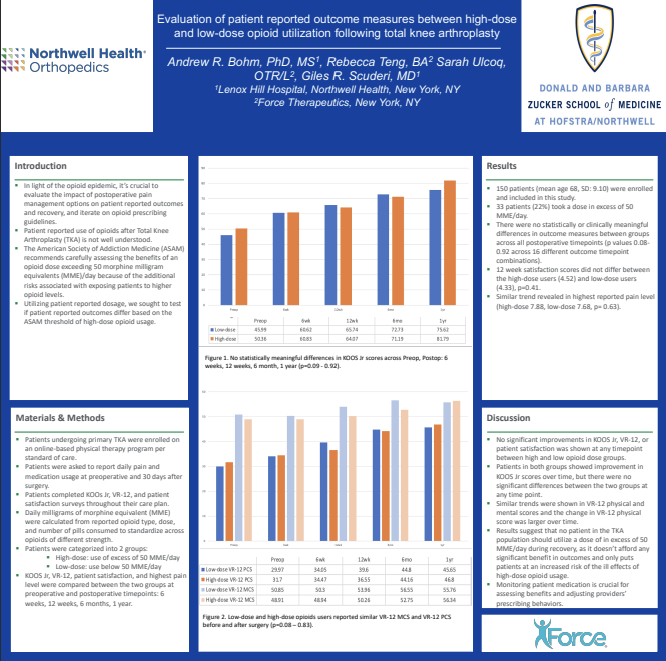
150 patients (mean age 68, SD: 9.10) were enrolled and included in this study. 33 patients (22%) took a dose in excess of 50 MME/day. There were no statistically or clinically meaningful differences in outcome measures between groups across all postoperative timepoints (p values 0.08-0.92 across 16 different outcome timepoint combinations). 12 week satisfaction scores did not differ between the high-dose users (4.52) and low-dose users (4.33), p=0.41. Similar trend revealed in highest reported pain level high-dose 7.88, low-dose 7.68, p= 0.63).
Discussion
No significant improvements in KOOS Jr, VR-12, or patient satisfaction was shown at any timepoint between high and low opioid dose groups. Patients in both groups showed improvement in KOOS Jr scores over time, but there were no significant differences between the two groups at any time point. Similar trends were shown in VR-12 physical and mental scores and the change in VR-12 physical score was larger over time. Results suggest that no patient in the TKA population should utilize a dose of in excess of 50 MME/day during recovery, as it doesn’t afford any significant benefit in outcomes and only puts patients at an increased risk of the ill effects of high-dose opioid usage. Monitoring patient medication is crucial for assessing benefits and adjusting providers’ prescribing behaviors.